Short answer
Bury hose-faucet kit tubing as deep as the kit guide shows (Rain Bird’s drawings show about 7.75 in, so the heads sit flush). For a full system, the sources we read put laterals at 6 to 12 in and the always-pressurized main line at about 18 in. In cold climates the usual answer is to drain or blow out the pipe each fall, not to bury it below the frost line, unless your local code says otherwise.
Kit makers, irrigation designers and local rules each write for a different job, so they don’t agree on one depth. Below is the range, who says what, and how poly, PVC and PEX differ. Every kit named here is in our sprinkler system kit comparison.
Before any trench: call 811 or Click Before You Dig
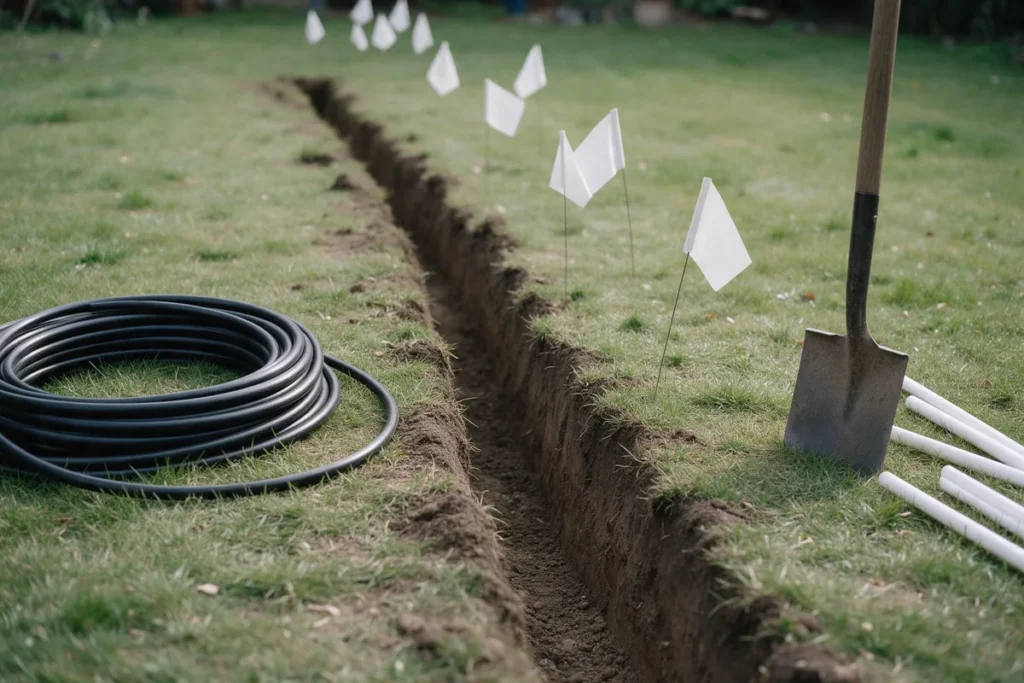
811 says any digging needs a locate request, even planting a garden, so a shallow sprinkler slot counts. Rain Bird’s kit guides say to call at least 24 hours ahead, but most places want more notice: two working days in Texas, three working days in British Columbia, Alberta, Saskatchewan and Manitoba, and five business days in Ontario.
Safety: request a locate before every digging job. In the US, contact 811, wait until every utility on your ticket has responded, and keep 18 to 24 in from each mark on every side; check your state 811 center’s rules before digging closer or using a trencher. In Canada, start at Click Before You Dig, which links to each province’s one-call center. Alberta asks you to expose any line within 1 m of a mark with hand tools, and BC 1 Call says to hand dig to expose marked services before using any machine.
Your own lines may not be marked. Alberta’s and Manitoba’s one-call services say customer-owned sprinkler lines aren’t marked, and Sask 1st Call says locating private lines is generally the landowner’s job. We found no US source on whether 811 covers private lines, so ask your 811 center and treat anything you or a previous owner buried as unmarked.
How deep each kind of pipe goes
Sources measure slightly differently (trench depth, pipe depth or soil cover), so treat small gaps as noise.
| Pipe or tubing | Depth given | Who says so |
|---|---|---|
| Hose-faucet kit tubing (Rain Bird 32ETI, 32HE) | Heads flush with the lawn; about 7.75 in in the drawings | Rain Bird kit guides |
| Hose-faucet kit tubing (Orbit 50020, 50021, 50024) | Not stated on the Orbit pages we read | Orbit product and help pages |
| Laterals (zone valve to heads) | 6 to 12 in, typical trench | Rain Bird installation guide |
| Laterals at a home | 8 to 10 in (12 in on commercial jobs) | Irrigation Tutorials |
| Laterals on city contracts | 350 mm (about 14 in) | City of Lethbridge, Alberta, construction spec |
| Main line (always under pressure) | At least 18 in to the top of the pipe | Irrigation Tutorials |
| Main line on city contracts | At least 450 mm (about 18 in) of cover | City of Lethbridge spec |
| Any irrigation pipe in Texas | At least 6 in of cover unless the maker says otherwise | Texas rule 30 TAC 344.62 |
| Drip tubing | On the surface, under mulch | Colorado State University Extension |
Hose-faucet kits: follow the box
Rain Bird’s 32ETI and 32HE guides have you cut slots with a flat spade or half-moon edger until the sprinkler tops sit flush, after staking the heads and test-running the layout. The 32ETI also puts a drain valve at the lowest end of each run, with the tubing sloping down to it, so the buried lines empty for winter. Orbit’s pages we read don’t give a depth for its Blu-Lock kits, so keep the printed guide. 32ETI owners we read report five to eight hours of digging alone.
Laterals and the main line
Laterals run from each zone valve to the heads and hold pressure only while their zone runs. Rain Bird’s installation guide gives 6 to 12 in as typical; Irrigation Tutorials, a long-running irrigation design site, says 8 to 10 in at a home, warning that pipe at 6 in often gets hit by aerating and dethatching. In Texas, rule 344.62 sets 6 in of cover as the floor, and homeowners installing their own system must still follow it. Most of the guidance overlaps at 8 to 12 in.
The main line, from your connection and backflow preventer to the valves, stays under pressure all season, and a break there stops every zone. That is why Irrigation Tutorials and Lethbridge’s spec both put it about 18 in down. Lay the valve wires beside or below the pipe, never above, so the pipe shields them; Rachio asks for direct-burial wire at least 8 in deep with splices sealed in silicone-filled connectors.
Drip lines: on top, under mulch
Colorado State University Extension runs drip main line over weed fabric and under mulch, out of the light and out of the way of feet. If you bury the half-inch supply, DIG’s GE200 guide keeps the drippers above ground on quarter-inch tubing, and Mister Landscaper advises against burying its dripline. Kits are compared in our drip irrigation kit comparison.
Cold winters: below the frost line, or drained each fall?
Water expands by about one-eleventh as it freezes, which Colorado State University Extension says is enough to split pipes, valves and sprinkler bodies. You can bury pipe below the depth the ground freezes, or take the water out before winter. Irrigation Tutorials calls the second the more common way: if you drain or blow out the main line every fall, it doesn’t need to sit below the frost line unless your local building officials say so. Lethbridge’s spec, written for a southern Alberta city, pairs its 18 in main line with drain valves at each system’s low points. If you aren’t sure what your town expects, ask its permits office before you dig.
What must stay frost-free is the part that holds water all winter: the supply and the shut-off valve where irrigation tees off your house’s water. Irrigation Tutorials puts that shut-off somewhere it won’t freeze; Colorado State Extension describes buried stop-and-waste valves that can sit 5 ft down. Pipe choice matters here too: Rain Bird says poly copes better with freezing, and Colorado State’s blowout limits are 80 psi of air for rigid PVC but 50 psi for poly. The full fall routine is in how to winterize a sprinkler system, drip kit and hose timer.
Aerators, edgers and spades: the other reason to go deeper
University of Tennessee Extension describes core aerators pulling cores about 2 to 6 in or more long, and dethatching mowers that can be set to cut into the soil. Colorado State Extension notes how easily surface drip lines get cut during yard work. Kit tubing along a path is in reach of an edger too: Rain Bird places 32HE heads 3 to 4 in from a sidewalk.
- Flag heads and runs before anyone aerates, and tell whoever runs the machine.
- Keep a map: photos of the open trenches, with distances from the house or path.
- Watch for puddles. Rain Bird says one can mean nicked tubing: dig around it, cut out the damage and join the ends with a 1/2 in barbed coupling.
Poly, PVC or PEX: what each is and how it joins
Each pipe joins in its own way, so mixing them means adapters.
| Pipe | What it is | How it joins | Where the sources use it |
|---|---|---|---|
| Poly (polyethylene) | Flexible black tubing; copes with freezing better than PVC | Barbed insert fittings with a clamp over the barbs, or locking fittings with a rubber seal | Cold-climate laterals; Rain Bird doesn’t recommend it for the main line |
| Kit tubing | Half-inch tubing made for one kit | Rain Bird: push-in tees and elbows. Orbit Blu-Lock: slide-on collars, no glue, tape or clamps | Only within that kit’s stated limits |
| PVC | Rigid pipe, sold in schedules and pressure classes | Solvent weld: primer, then cement, pushed together with a quarter turn | Main lines and laterals where winters are mild |
| PEX | Cross-linked polyethylene, a household plumbing tube | Plumbing-grade PEX fittings on a main line | Main lines where frosts are hard (Irrigation Tutorials only) |
| Swing pipe and swing joints | Short flexible links from a buried lateral up to a head | Barbed fittings (swing pipe) or threaded fittings (swing joint) | Setting each head to grade without stressing the pipe |
Poly handles a freeze better than PVC, which is why Rain Bird says it is used mostly in cold climates; the catch is its lower pressure rating. Irrigation Tutorials allows poly rated 160 or 200 psi on frost-area main lines on one page and prefers PEX on another. Cold poly is stiff: warm it in the sun or hot water, never with a flame.
PVC is the default where the ground doesn’t freeze, with schedule 40 for main lines, according to Irrigation Tutorials. It takes more air in a blowout than poly but copes worse with water freezing inside it. Rain Bird and Irrigation Tutorials both describe primer, then cement, pushed home with a quarter turn.
PEX is the least settled. Irrigation Tutorials calls it the better main line where frosts are hard: stronger than poly, still flexible and less likely to be damaged by a light frost. It carries less water than poly of the same size, so size up, and needs plumbing-grade fittings. We found no extension or irrigation-maker guidance on PEX for sprinklers, so check the PEX maker’s installation guide and your plumbing inspector; not every building official allows PEX in a basement.
Which applies to you
A hose-faucet kit on a small lawn. Follow the guide, slope the tubing to the drain valves, and don’t add pipe: Rain Bird warns that extra tubing or rotors can stop the Rain Bird 32ETI’s heads turning or popping up. It has six rotors, 125 ft of tubing and two automatic drain valves.
A bigger lawn on one faucet. The Orbit 50021 splits twelve sprinklers over two zones on 250 ft of push-fit tubing, with auto drain valves. It needs at least 50 psi and 5 gpm; keep its printed guide for the depth.
- A full system where winters are mild: PVC laterals at 8 to 12 in and a main line at about 18 in. In Texas, 6 in of cover is the minimum, not the target.
- A full system in the northern US or Canada: the same depths, plus drain valves at the low points, a shut-off somewhere warm and a fall blowout within your pipe’s air-pressure limit.
Still deciding? Read hose-faucet kit or full in-ground system, how many heads per zone and do I need a backflow preventer, or see the best DIY sprinkler system kits.
How we put this together
- Read the depth guidance in Rain Bird’s kit and installation guides, Orbit’s kit pages, Texas’s irrigation rules and a City of Lethbridge construction spec.
- Added Colorado State and University of Tennessee Extension guidance, and an irrigation design site where official sources are silent.
- Checked locate rules with 811 and the provincial one-call centers.
- Said plainly where sources disagree or say nothing, as on PEX.
What we don’t do: dig trenches or install systems to test them. Local codes change, so check yours.
Pipe depth questions
Do sprinkler pipes have to go below the frost line?
Usually not, if you remove the water every fall. Irrigation Tutorials says draining or blowing out the main line before winter is the more common approach and makes frost-depth burial unnecessary, unless local building officials require it. The supply pipe and shut-off valve that stay full all winter still need frost protection.
Is a 6-inch trench deep enough for sprinkler pipe?
It is the shallow end of the range. Rain Bird’s typical trench starts at 6 in and Texas sets 6 in of cover as its minimum, but Irrigation Tutorials says laterals that shallow often get damaged by aerating and dethatching, and suggests 8 to 10 in at a home. Main lines go deeper, at about 18 in.
Will a core aerator hit my sprinkler lines?
It can if they are shallow. University of Tennessee Extension describes core aerators pulling cores about 2 to 6 in or more long, so tubing in the top few inches is at risk. Flag every head and the runs between them before the machine arrives. Rain Bird says a puddle afterward can mean nicked tubing.
Can I use PEX instead of PVC for a sprinkler main line?
Some designers recommend it where winters are hard: Irrigation Tutorials prefers PEX for frost-area main lines because it is stronger than poly and still flexible. We found no extension or irrigation-maker guidance on it, though. Check the PEX maker’s burial instructions and your local plumbing code, and use plumbing-grade fittings.
Will the utility locate mark my old sprinkler lines?
Not in several provinces. Alberta’s and Manitoba’s one-call services say customer-owned sprinkler lines aren’t marked, and Sask 1st Call says finding private lines is generally the landowner’s job; a private locator can help. We found no US source on 811 and private lines, so ask your state 811 center and treat lines you or a previous owner buried as unmarked.